

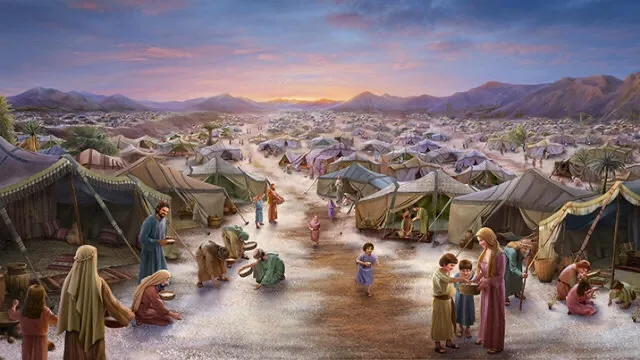
After the Israelites left Egypt they experienced hunger. In Egypt they worked hard and were at the mercy of those who enslaved them. Even as slaves, they had enough food. It was provided for them. In the wilderness, they had to fend for themselves. There wasn’t much in the desert to eat and there were a ton of moths to feed. They were hungry! (Exodus 16:3). In answer to prayers, the Lord provided “bread from heaven” (Exodus 16:4).
God called it “bread from heaven.” They called it “manna,” which translates to “WHAT IS IT?” God gave them instructions on how to gather and use it. They didn’t always follow the instructions. God told them its name. They didn’t listen. It seems like they had a lot to learn.
God told them:
- Gather only what you need for the day. Don’t hoard it; it will go bad overnight.
- On the sixth day of the week, gather twice as much. There will be no bread on the sabbath, and the bread from the prior day would stay fresh.
Seems simple enough, but not simple enough to keep the people from pushing the boundaries. Some people tried to gather extra and to store it for future use. They seem surprised that “it bred worms, and stank” (Exodus 16:20). Some people tried to gather bread on the sabbath, but “they found none” (Exodus 16:27). Understandably, Moses was frustrated with their lack of trust.
They lived like this for 40 years. That is how long it took them to learn – God’s blessings come incrementally, Don’t expect them all at once. And, God expects us to observe the sabbath day, to make it different from a regular workday.
Elder D. Todd Christofferson taught, “ By providing a daily sustenance, one day at a time, Jehovah was trying to teach faith to a nation that over a period of some 400 years had lost much of the faith of their fathers. … In essence, the children of Israel had to walk with Him today and trust that He would grant a sufficient amount of food for the next day on the next day, and so on. In that way He could never be too far from their minds and hearts” (Give Us This Day Our Daily Bread, January 2011).
Give me cause to pause. Do I trust the Lord to give me what I need day to day, or do I “store up” spiritual and temporal nourishment “just in case?”
People asked Jesus for another sign when He fed a multitude with five loaves and two fishes. They referenced Moses giving “bread” to their ancestors. Jesus responded with “I am that bread of life (John 6:48-50).
When the Savior performed a miracle by providing bread and wine for the sacrament for the Nephites, He taught, “He that eateth this bread eateth of my body to his soul; and he that drinketh of this wine drinketh of my blood to his soul; and his soul shall never hunger nor thirst, but shall be filled” (Nephi 20:8).
Mannan provided temporary nourishment to the hungry, but Jesus provided permanent nourishment to the hungry soul.
As I take the sacrament each week I am reminded “that we have Him of whom monna was a type and symbol, the very Bread of Life, the Redeemer” (Christofferson).
Not only am I nourished as I partake of the sacrament each week, The Lord provides nourishment in scriptures, living prophets and personal revelation. Each day I have the opportunity to dine at the feet of the Bread of Life when I prayerfully approach Him to learn, for repent and to grow. Each day I am given the opportunity to trust God to give me the bread from heaven. Each day I am given the opportunity to recognise that His blessings come a little at a time and according to His pattern.


