
Choosing Faith When You’re Afraid to Take the Next Step
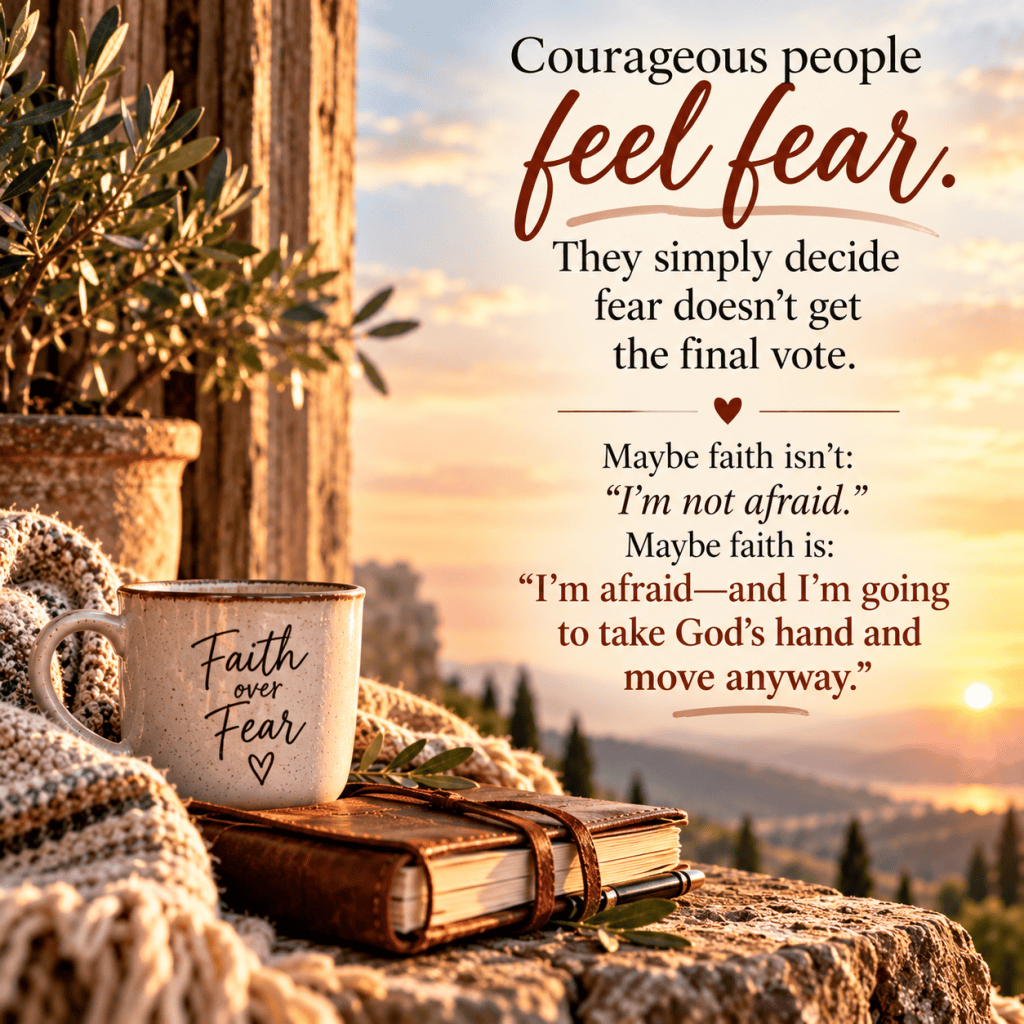
“Courageous people feel fear. They simply decide fear doesn’t get the final vote.”
Have you ever stood at the edge of something new and felt afraid?
Maybe it was a decision you knew you needed to make.
Maybe it was a conversation you’d been avoiding.
Maybe it was an opportunity that excited you but also made you question whether you were capable of succeeding.
Or maybe life changed unexpectedly, and suddenly you found yourself facing a future you never planned.
You wanted to be brave. You wanted to feel confident. You wanted to trust God completely. But deep inside, you were scared. And perhaps you wondered, “If I really trusted God, wouldn’t I feel less afraid?”
Here’s something I hope you’ll remember:
Courage doesn’t mean you never experience fear. It means fear doesn’t get to make every decision for you.
And sometimes, the greatest expression of faith is a simple, trembling prayer:
“God, I’m afraid. But I’m going to take Your hand and move forward anyway.”
We Have the Wrong Idea About Courage
We often imagine courageous people as fearless. We picture someone standing tall, speaking confidently, taking risks, and moving forward without hesitation. We assume they must have something we don’t. More confidence. More strength. More certainty. Maybe even more faith.
But what if we’ve misunderstood courage? What if the person who looks brave on the outside is fighting the same doubts we experience? What if they’ve simply learned that fear can be present without being in charge?
Think about it.
It doesn’t take much courage to do something that doesn’t scare us. Courage becomes meaningful when something matters enough that we choose to move forward despite our uncertainty.
The parent who keeps showing up during a difficult season is courageous.
The person who begins again after disappointment is courageous.
The woman who finally sets a healthy boundary is courageous.
The man who admits he needs help is courageous.
The person who chooses forgiveness, even while still working through the hurt, is courageous.
And the person who whispers, “Lord, I don’t know if I can do this, but I’m willing to try,” is courageous too.
Courage isn’t always loud. Sometimes it’s the quiet decision to take one more step.
Faith Doesn’t Require Us to Pretend We’re Not Afraid
Somewhere along the way, many of us began believing that fear and faith cannot exist together. We think that if we truly trust God, we should never feel anxious, uncertain, or overwhelmed. So we hide our fears. We tell everyone we’re fine. We smile when we’re struggling. We try to convince ourselves that being afraid means we’re somehow failing spiritually.
But God doesn’t ask us to pretend. He already knows what’s happening in our hearts. He knows the worries we carry, the questions we haven’t answered, and the situations that make us feel vulnerable. We don’t have to impress Him with artificial confidence. We can come to Him honestly.
Psalm 56:3 says:
“What time I am afraid, I will trust in thee.” — Psalm 56:3 (KJV)
I love the honesty of that verse.
David didn’t say he would never experience fear. He said that when fear came, he would choose to trust God. That is such an important distinction.
Faith doesn’t always sound like:
“I’m not afraid.”
Sometimes faith sounds like:
“I’m afraid, but I know God is with me.”
“I’m uncertain, but I believe He will give me wisdom.”
“I don’t know how this will turn out, but I’m willing to take the next right step.”
“My heart is trembling, but I’m not going to let fear decide my entire future.”
We can be honest about our emotions and still choose to trust God.
Fear Is a Feeling, Not Always a Final Answer
Fear has a purpose. It can alert us to danger, encourage caution, and remind us to think carefully before making important decisions. Not every fear should be ignored. Sometimes fear tells us to seek safety, gather more information, or ask for help. But fear can also become a habit. It can convince us that uncertainty automatically means danger. That making a mistake would be unbearable. That we’re not capable. That we should wait until everything feels safe and predictable before taking action. And that’s where fear can begin holding us back.
Maybe you’ve heard these thoughts:
What if I fail?
What if people criticize me?
What if I’m not good enough?
What if I make the wrong decision?
What if things don’t work out the way I hope?
Those questions can feel so convincing that we begin treating them as facts.
But just because fear has something to say doesn’t mean it deserves the final vote.
We can listen to our concerns without surrendering every decision to them. We can evaluate risks wisely. We can seek counsel. We can pray. And then, when the next step is appropriate, we can move forward.
Sometimes the question we need to ask isn’t, “Am I afraid?”
It’s:
“Is this fear protecting me from real danger, or preventing me from doing something meaningful?”
That question can change the way we approach our lives.
God Often Calls Ordinary People to Do Difficult Things
When we read the Bible, it’s easy to focus on the victories and forget the uncertainty people experienced along the way.
Moses questioned whether he was capable of leading God’s people.
Gideon struggled to see himself as the person God was calling.
Esther faced a dangerous decision that required extraordinary courage.
Joshua was stepping into leadership after Moses, facing responsibilities that must have felt enormous.
These were not people who always had everything figured out.
They were human beings facing difficult circumstances.
And God met them there.
In Joshua 1:9, God says:
“Have not I commanded thee? Be strong and of a good courage; be not afraid, neither be thou dismayed: for the LORD thy God is with thee whithersoever thou goest.” — Joshua 1:9 (KJV)
Notice the reason Joshua could move forward. It wasn’t because he had complete control over the future. It wasn’t because the journey would be easy. It was because God promised to be with him. And that promise matters for us, too.
We may not be leading a nation or facing the same challenges as Joshua, but we know what it’s like to stand before something bigger than ourselves.
A new beginning.
An uncertain diagnosis.
A difficult relationship.
A major life transition.
A dream that requires us to step outside our comfort zone.
God’s presence doesn’t guarantee that every outcome will match our expectations. But it reminds us that we don’t have to face life’s challenges without Him.
Sometimes the Next Step Is All We Need to See
One of the reasons fear becomes overwhelming is that we try to figure out the entire journey before taking the first step.
We want guarantees. We want a detailed plan. We want to know that everything will work out exactly as we hope. But life rarely gives us that kind of certainty.
And sometimes God invites us to trust Him one step at a time.
Psalm 119:105 says:
“Thy word is a lamp unto my feet, and a light unto my path.” — Psalm 119:105 (KJV)
Think about that image.
A lamp doesn’t necessarily illuminate every mile of the road. It gives enough light to see where to place our feet.
Maybe that’s what you need today. Not a complete picture of the next five years. Not answers to every question. Not absolute certainty about every outcome. Just enough wisdom and courage for the next step.
Perhaps your next step is making an appointment you’ve been putting off. Perhaps it’s having an honest conversation. Perhaps it’s applying for an opportunity. Perhaps it’s asking for forgiveness. Perhaps it’s establishing a boundary. Perhaps it’s finally allowing yourself to rest. Or perhaps your next step is simply praying:
“God, I don’t know what to do. Please help me recognize the next right thing.”
You don’t have to conquer the entire mountain today. You can begin with the next faithful step.
What If You Fail?
Let’s talk about one of the biggest reasons people allow fear to make their decisions.
The possibility of failure.
We worry that trying something new might lead to embarrassment, disappointment, or regret. We imagine what other people might say. We wonder whether we’re strong enough to recover if things don’t go well. So sometimes we choose not to try. After all, if we never begin, we never have to risk failing. But we also miss the possibility of growing. Learning. Discovering new abilities. Developing resilience. And experiencing opportunities we couldn’t have imagined.
Failure is not something we should seek carelessly, but neither does every setback mean we’ve made the wrong choice.
Sometimes we learn through mistakes.
Sometimes a closed door redirects us.
Sometimes we discover that we need more preparation.
And sometimes we learn that we are stronger and more resourceful than we believed.
God can work in our lives through seasons of success and through seasons of disappointment.
Our worth is not determined by whether everything goes perfectly.
You are not required to succeed at everything to live a meaningful, faithful life.
You are allowed to learn.
You are allowed to grow.
You are allowed to begin again.
Taking God’s Hand Doesn’t Mean We Stop Being Responsible
There’s something important I want to clarify.
Trusting God doesn’t mean ignoring warning signs, making reckless decisions, or refusing to prepare.
Faith and wisdom belong together.
Sometimes the courageous choice is to move forward.
Other times it’s to wait.
Sometimes it’s to speak.
Other times it’s to listen.
Sometimes it’s to pursue an opportunity.
Other times it’s to walk away from something harmful.
Taking God’s hand means seeking His guidance rather than allowing panic or pressure to control us.
Proverbs 3:5–6 reminds us:
“Trust in the LORD with all thine heart; and lean not unto thine own understanding. In all thy ways acknowledge him, and he shall direct thy paths.” — Proverbs 3:5–6 (KJV)
We can pray and make thoughtful plans.
We can trust God and ask for wise counsel.
We can have faith and acknowledge that some situations require professional support, careful preparation, or firm boundaries.
Courage is not the same as recklessness.
Sometimes the bravest thing we can do is slow down long enough to make a wise decision.
And sometimes the bravest thing is finally taking action after we’ve spent too long allowing fear to keep us still.
A Simple Practice for When Fear Feels Bigger Than Faith
The next time fear begins taking over your thoughts, try giving yourself a quiet moment to work through it.
First, name what you’re afraid of.
Be specific.
Instead of saying, “I’m afraid of the future,” ask yourself what part of the future feels frightening.
Is it uncertainty?
Financial security?
Someone else’s opinion?
The possibility of disappointment?
Naming a fear can help us understand what we’re facing.
Second, ask whether the fear is pointing to a real concern.
Is there something you need to prepare for?
A question you need answered?
A person you need to speak with?
A boundary you need to establish?
Take those concerns seriously.
Third, bring the fear to God.
You don’t need an elaborate prayer.
Sometimes the most meaningful prayer is:
“Lord, I’m scared. Please give me wisdom and courage.”
Fourth, identify one small, responsible step.
Don’t demand that you solve everything today.
Choose one action that moves you toward what matters.
Finally, remind yourself that fear doesn’t have to disappear before you act.
You can take a wise step while still feeling uncertain.
You can be nervous and capable.
You can be afraid and faithful.
You can move forward without knowing exactly how everything will unfold.
The Final Vote Belongs to Faith
Maybe today you’re facing something that scares you.
Maybe you’ve been waiting to feel more confident before making a decision.
Maybe you’ve convinced yourself that courageous people don’t struggle with doubt.
But I want you to remember this:
Courageous people feel fear.
They experience uncertainty.
They question themselves.
They sometimes wish they could turn around and return to what feels familiar.
But they also learn that fear doesn’t have to be the only voice they listen to.
They seek wisdom.
They pray.
They take responsibility for what they can control.
And when the time is right, they choose to move forward.
You don’t have to wake up tomorrow feeling completely fearless.
You don’t have to know how every chapter of your story will unfold.
You don’t have to become a different person before you can begin.
You can start right where you are.
With the faith you have.
With the questions you carry.
With the courage to take one small step.
And when fear whispers, “What if you can’t do this?”
You can answer:
“Maybe I can’t do everything. But I can take the next step with God’s help.”
Because perhaps faith isn’t saying:
“I’m not afraid.”
Perhaps faith is saying:
“I’m afraid—and I’m going to take God’s hand and move anyway.”
And sometimes, that one decision changes everything.


